
- Total vs. Partial Knee Replacement: What’s the Difference?
- How to Know if You’re a Candidate for Partial Knee Replacement
- The Recovery Benefits of PKR
- How Long Does a Partial Knee Replacement Last?
- How to Get a Definitive Diagnosis and Treatment Plan
- Frequently Asked Questions (FAQ)
- Find Out Which Option Is Right for You
When considering knee replacement surgery, many patients assume a total knee replacement is the only option. However, for many patients at Southern Indiana Orthopedics, a partial knee replacement (PKR) may actually be the better choice.
Under the expertise of Dr. Travis Clegg, we specialize in advanced, muscle-sparing knee replacement techniques that prioritize a faster return to the activities you love. Here is what you need to know about the differences between partial and total knee replacements and how to identify if you are a candidate for a less invasive approach.

Total vs. Partial Knee Replacement: What’s the Difference?
The knee is divided into three main compartments: the medial (inside), the lateral (outside), and the patellofemoral (front/under the kneecap).
- Total Knee Replacement: All three compartments of the knee are replaced with metal and plastic components.
- Partial Knee Replacement: Only the damaged portion of the knee is replaced, leaving the healthy bone, cartilage, and ligaments in the other compartments untouched.
How to Know if You’re a Candidate for Partial Knee Replacement
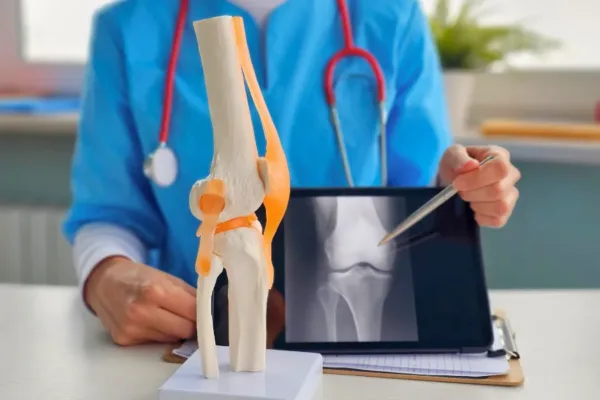 While a total knee replacement is a highly successful procedure, a partial knee replacement is often preferred when the damage is localized. You may be an ideal candidate if:
1. Your pain is on one side of the knee
Partial knee replacement is specifically designed for “unicompartmental” arthritis. If your pain and stiffness are strictly located on either the inside or outside of your knee, you may not need a full replacement.
2. Your ligaments are stable
To be a candidate for PKR, your ACL (anterior cruciate ligament) and other supporting ligaments must be healthy and intact. Because the partial procedure preserves these natural ligaments, the knee often feels more “natural” during movement than a total replacement.
3. You have limited (not widespread) arthritis
If your arthritis has spread to multiple areas of the knee, a total replacement is usually necessary to ensure long-term relief. However, if imaging shows that your cartilage damage is confined to one area, PKR is a viable, bone-preserving solution.
4. You have good range of motion
Candidates for PKR typically still have a decent range of motion and do not have significant stiffness or a major deformity (like being severely bow-legged or knock-kneed).
The Recovery Benefits of PKR
Choosing a partial knee replacement vs total replacement offers several distinct advantages during the recovery phase:
- Muscle-Sparing Approach: Because the incision is smaller and less bone is removed, there is significantly less trauma to the surrounding soft tissue.
- Faster Recovery: Most PKR patients experience a quicker return to walking and daily activities compared to total knee patients.
- Less Pain: Reduced surgical trauma generally leads to a more comfortable post-operative experience.
- Better Function: Because your natural ligaments are preserved, many patients report that the knee feels more stable and real when climbing stairs or walking on uneven ground.
How Long Does a Partial Knee Replacement Last?
Modern advancements in implant technology and surgical precision have greatly improved longevity. Current data suggests that for the majority of patients, a partial knee replacement can last 15 to 20 years.
While there is a slightly higher risk of needing a revision (switching to a total replacement) later in life compared to starting with a total replacement, the benefits of a faster recovery and better joint feel make it a highly attractive option for active adults.
How to Get a Definitive Diagnosis and Treatment Plan
The only way to know for certain which procedure is right for you is through a comprehensive orthopedic evaluation. Dr. Travis Clegg uses advanced imaging and physical assessments to determine the exact extent of your joint damage.
Not sure where to start? Take our quick Knee Pain Self-Assessment Quiz to see how your symptoms rate.
Frequently Asked Questions (FAQ)
Find Out Which Option Is Right for You
If you’re ready to discuss your options for a muscle-sparing knee replacement, schedule a consultation with Southern Indiana Orthopedics today. Let’s get you back to living life without limits.
Take our Knee Pain Self-Assessment or Schedule a Consultation with Dr. Travis Clegg to get a definitive diagnosis.